Morocco · Moroccan cuisine of Marrakech (tanjia)
Tanjia marrakchia
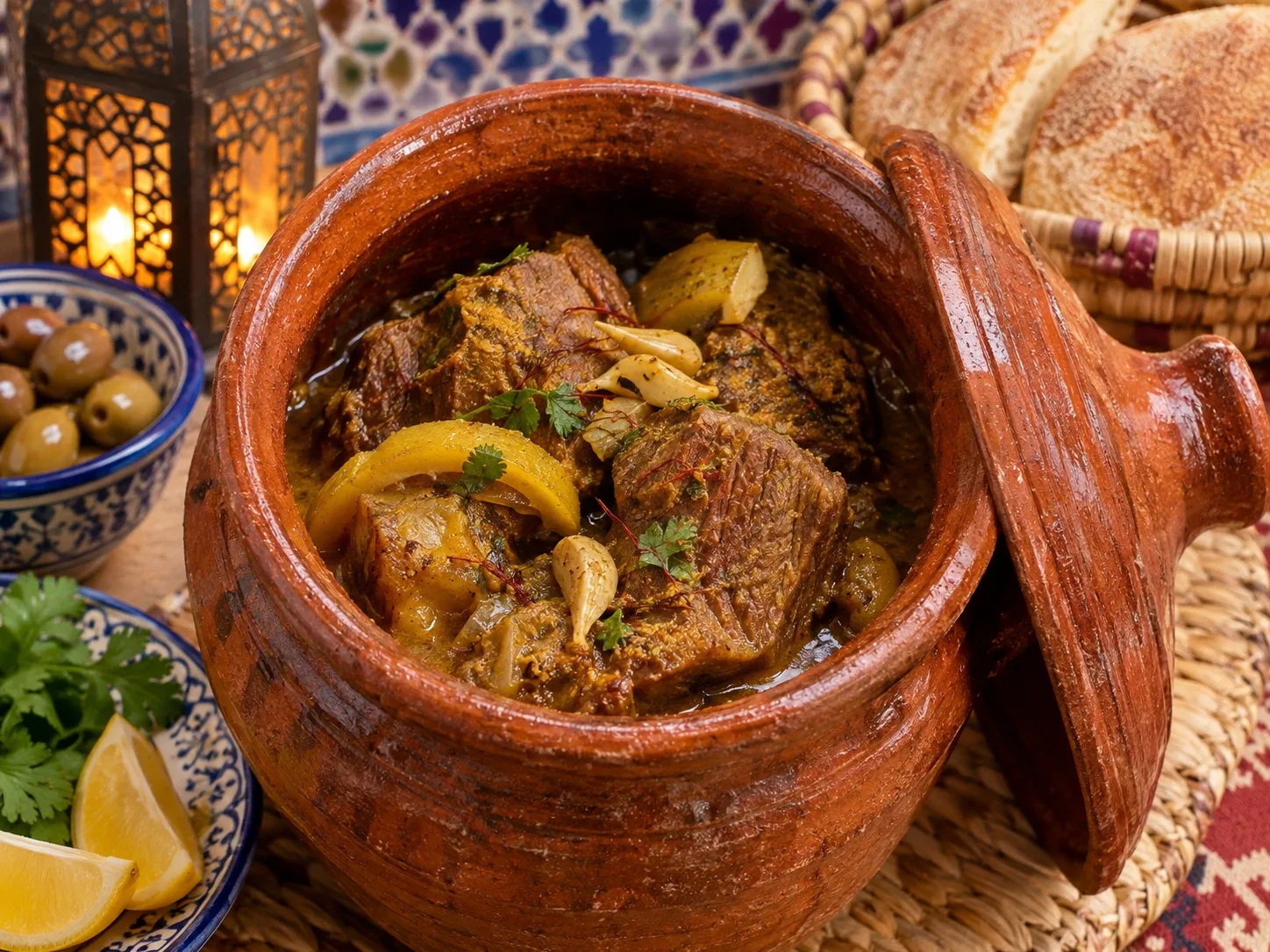
A shank of veal slow-cooked for hours in a covered pot with garlic, cumin, saffron and preserved lemon until it melts off the bone in a rich, glossy, aromatic sauce.
Cookhuddle Editorial Cookhuddle | Morocco

Editorial selection: recipes cross-checked against several documentary sources. They have not been tested in our kitchen: follow the precautions given and adapt times to your own oven.
translation Translated from French. Translation by Cookhuddle Editorial. Read the original
Read this recipe inespañol · translationfrançais · originalEnglish · translation
- Servings
- 4
- Preparation
- 15 min
- Cooking
- 195 min
- Resting
- 15 min
- Total
- About 225 min
- Difficulty
- Easy
Cuisine / tradition: Moroccan cuisine of Marrakech (tanjia) (MA) — declared by the author
- Main dish
- Slow-cooked
- Baked
Ingredients
For 4 servings
- 1.2 kg veal or beef shank, in 4 thick slices on the bone
- 6 clove garlic cloves, unpeeled and lightly crushed
- 2 tsp ground cumin
- 1 tsp ras el hanout
- 1/2 tsp ground black pepper
- 1 pinch saffron threads, dissolved in 2 tablespoons warm water
- 1 piece preserved lemon, quartered, pulp and rind
- 50 g smen (or butter)
- 3 tbsp olive oil
- 150 ml water
Method
- Step 1. Heat the oven to 150 degrees C. Put the shank slices, garlic, cumin, ras el hanout, pepper, the saffron with its water, the preserved lemon, the smen, the olive oil and the water in a cast-iron casserole whose lid is oven-safe, just big enough to hold the meat. Mix well with your hands so that every slice is coated.
- Step 2. Put the lid on, used as the manufacturer directs. Do not try to make the casserole airtight or pressure-tight, and do not add paper or string under the lid. Put it in the oven.
- Step 3. Cook at 150 degrees C for about 3 hours to 3 hours 30 minutes, and up to 4 hours for very thick slices or for beef, without opening it during the first 2 hours 30 minutes. From 2 hours 30 minutes, check every 20 to 30 minutes, opening the lid carefully away from your face (the steam is scalding): it is ready only when the meat is truly melting and comes off the bone easily when pressed with a fork. If it is not, put the lid back and cook on. If the juices have almost evaporated, add 100 ml of hot water.⏱ 180 min
- Step 4. Take the casserole out and leave it to rest, covered, for 15 minutes. If the juices are thin, transfer them to a small saucepan suitable for the hob and reduce them over medium heat for 5 minutes, then pour them back over the meat. Taste the juices and add salt only now, if needed.⏱ 15 min
- Step 5. Serve hot, straight from the casserole or in a deep dish, with the juices, the soft garlic and the preserved lemon, and Moroccan bread to mop up the sauce.
Story and cultural note
The tanjia is an emblematic dish of Marrakech and the name of the urn-shaped earthenware jar, made for cooking, in which it is prepared. Traditionally the jar, filled with meat, spices and preserved lemon and closed with paper tied with string or wire, is taken to the fernatchi, the oven keeper, who cooks it slowly for many hours in the embers of the public oven or in the heat of the hammam furnace. Veal shank is the traditional choice; goat, chicken or veal feet are also used, and white beans or vegetables are optional. This recipe is a domestic adaptation: a covered cast-iron casserole in a home oven, which does not reproduce the embers or the hammam.
Tips for success
The tanjia is a slow braise: let the meat, not the clock, tell you when it is done; the times given are estimates, not guarantees, and depend on the cut, the thickness and your oven. Use a cast-iron casserole just big enough for the meat so that the juices stay concentrated, and follow its maker's instructions for the lid. No salt is added at the start: preserved lemon and smen are already salty, so taste the juices at the end. Never put an earthenware jar on a flame or in an oven unless its maker states that it is designed for that use at that temperature.
Serving and presentation
Bring the casserole to the table and open it in front of your guests, carefully, for the aroma. Serve hot in deep plates with the juices, a clove of soft garlic and a piece of preserved lemon, with Moroccan bread to mop up the sauce.
Diet and allergens
Information declared by the author. CookHuddle does not verify or certify it. If you have an allergy, check the ingredients yourself.
ContainsMilk