Italy · Italian cuisine of Lazio (Rome)
Spaghetti alla carbonara
Spaghetti coated in a silky cream of egg yolks and Pecorino Romano, with crisp, golden guanciale and plenty of black pepper: a Roman classic made with just a few ingredients and no cream.
Cookhuddle Editorial Cookhuddle | Italy

Editorial selection: recipes cross-checked against several documentary sources. They have not been tested in our kitchen: follow the precautions given and adapt times to your own oven.
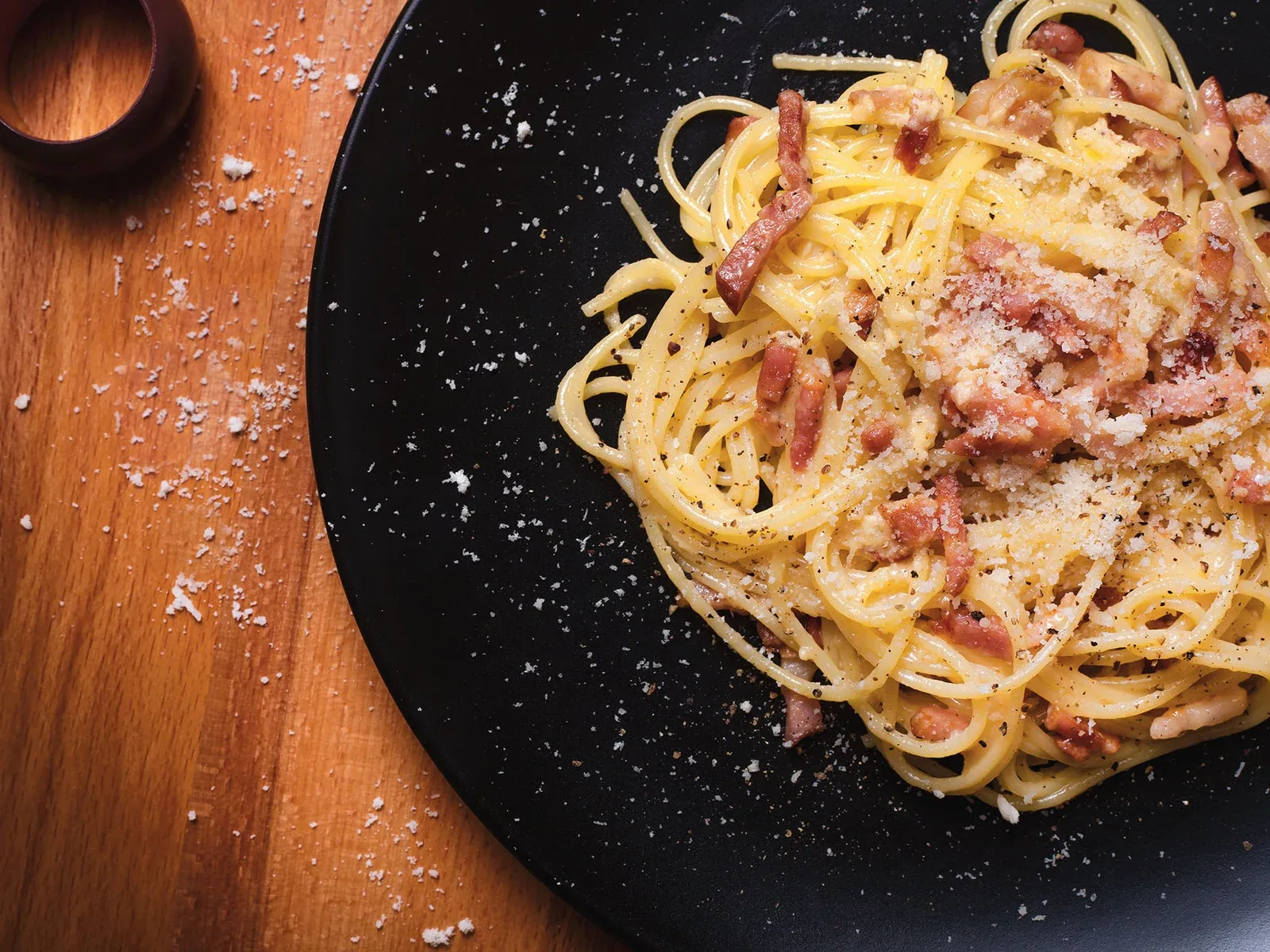
Photo: Javier Somoza · CC BY-SA 4.0 · Source · cropped
original Original text, written in English.
Read this recipe inEnglish · originalfrançais · translationespañol · translation
- Servings
- 4
- Preparation
- 8 min
- Cooking
- 20 min
- Total
- 28 min
- Difficulty
- Medium
Cuisine / tradition: Italian cuisine of Lazio (Rome) (IT) — declared by the author
- Main dish
- Quick
Ingredients
For 4 servings
- 360 g spaghetti
- 160 g guanciale (cured pork cheek), rind removed, in strips
- 4 piece egg yolks, very fresh
- 1 piece whole egg, very fresh
- 60 g Pecorino Romano, finely grated
- 2 tsp freshly ground black pepper, coarse
- 1 tbsp coarse salt, for the cooking water
- 4 l water, for the pasta
Method
- Step 1. Cut the guanciale into strips about 1 cm wide. Put them in a cold, dry wide pan, without oil.
- Step 2. Cook over low heat for 10 to 12 minutes, until the fat has melted and the strips are golden and crisp outside but still slightly soft inside. Turn off the heat and leave the guanciale and its fat in the pan.⏱ 12 min
- Step 3. Bring the water to the boil with the coarse salt (go lightly: guanciale and pecorino are salty). Cook the spaghetti for 1 minute less than the time on the packet, so that they are very al dente.⏱ 10 min
- Step 4. Meanwhile, in a large bowl whisk the egg yolks, the whole egg, the pecorino and most of the pepper into a thick, smooth cream.
- Step 5. Keep a cup (200 ml) of the pasta water, then drain the spaghetti and tip them into the pan with the guanciale, off the heat. Toss for 30 seconds so that the pasta takes up the fat.
- Step 6. Pour the pasta into the bowl with the egg cream and toss quickly, adding the pasta water a spoonful at a time, until the sauce is glossy and creamy and clings to the spaghetti. The eggs must set only from the heat of the pasta. Serve at once on warm plates with the rest of the pepper and a little more pecorino.
Story and cultural note
The sources agree that traditional carbonara has only guanciale, Pecorino Romano, eggs and black pepper, with no cream. Its origin is uncertain: one theory links it to cacio e ova, an old dish of cheese and eggs prepared by charcoal workers in the Apennines; another dates it to 1944 and American soldiers in Italy; a third credits the chef Renato Gualandi after the war. Pancetta in place of guanciale and parmigiano in place of pecorino are tolerated, but Roman cooks consider guanciale and pecorino the right choice.
Tips for success
Use very fresh eggs and mix the pasta and the egg cream off the heat: the heat of the pasta alone cooks the eggs to a cream. Add the cooking water a spoonful at a time; too much makes the sauce thin. Cook the guanciale slowly from cold so that it crisps without burning. Go light with salt in the water. The eggs are only warmed by the pasta and the pan, not truly cooked: pregnant women, young children, older people and immunocompromised people should use pasteurised eggs, or cook the sauce gently over very low heat, stirring, until it coats the spoon (at least 70 °C) instead of relying on the heat of the pasta alone.
Serving and presentation
Serve immediately in warm shallow bowls, twirled into a nest, with a final grind of coarse pepper and a little pecorino. Carbonara does not wait: it is best eaten as soon as it is plated.
Diet and allergens
Information declared by the author. CookHuddle does not verify or certify it. If you have an allergy, check the ingredients yourself.
ContainsGluten (cereals)EggsMilk