Italy · Neapolitan cuisine (Campania)
Pizza Margherita
A soft-edged Neapolitan pizza on a slowly risen dough, with crushed tomatoes, fior di latte mozzarella, fresh basil and olive oil, baked in the hottest oven you have.
Cookhuddle Editorial Cookhuddle | Italy

Editorial selection: recipes cross-checked against several documentary sources. They have not been tested in our kitchen: follow the precautions given and adapt times to your own oven.
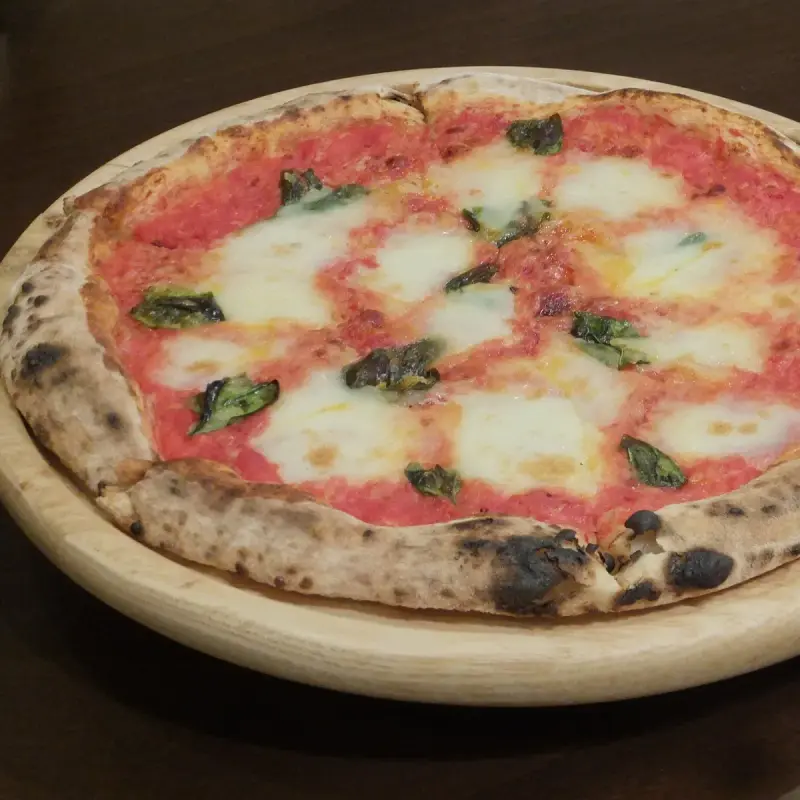
Photo: Lombroso · CC BY-SA 4.0 · Source
original Original text, written in English.
Read this recipe inEnglish · originalespañol · translationfrançais · translationDeutsch · translation
- Servings
- 4
- Preparation
- 40 min
- Cooking
- 30 min
- Resting
- 480 min
- Total
- 550 min
- Difficulty
- Medium
Cuisine / tradition: Neapolitan cuisine (Campania) (IT) — declared by the author
- Main dish
- Baked
Ingredients
For 4 servings
- 500 g "00" flour for pizza (strong, about 12-13 % protein)
- 325 ml water at room temperature
- 12 g fine sea salt
- 1 g fresh yeast (about a lentil-sized crumb)
- 2 tbsp semolina or flour, for dusting
- 400 g peeled tomatoes (San Marzano type), crushed by hand
- 1 pinch salt, for the tomatoes
- 250 g fior di latte mozzarella, drained and torn
- 16 piece fresh basil leaves
- 4 tbsp extra-virgin olive oil
Method
- Step 1. Stir the yeast into the water until dissolved. Add the flour and mix until no dry flour is left. Cover and rest for 20 minutes, then add the salt and knead for 8 to 10 minutes, until the dough is smooth and elastic.⏱ 10 min
- Step 2. Cover the dough and let it rest for 1 hour at room temperature.⏱ 60 min
- Step 3. Divide the dough into 4 balls of about 210 g (the traditional range is 180 to 250 g). Tuck the edges underneath to get a smooth, tight surface and place them, well apart, in a lightly floured covered box or on a floured tray under a cloth.
- Step 4. Let the balls rise for 8 hours at about 20 °C, or for 18 to 24 hours in the refrigerator, taking them out 2 hours before baking. They should be soft, airy and almost doubled.
- Step 5. Crush the tomatoes by hand with a pinch of salt. Tear the drained mozzarella into pieces and pick the basil leaves.
- Step 6. Put a baking steel or stone on a rack in the top third of the oven and preheat it at the maximum temperature (250 to 300 °C) for at least 45 minutes.⏱ 45 min
- Step 7. Dust a ball with semolina and stretch it by hand on a floured surface, from the centre outwards, to a disc of 28 to 30 cm with a thin centre and a thicker rim of 1 to 2 cm. Never use a rolling pin.
- Step 8. Spread about 100 g of tomatoes over the disc, leaving the rim bare, and add a quarter of the mozzarella and a drizzle of oil. Slide the pizza onto the hot steel and bake for 5 to 8 minutes, until the rim is puffed and golden with dark spots and the cheese bubbles. Repeat with the other pizzas.⏱ 7 min
- Step 9. Take out the pizza, scatter 4 basil leaves on it and finish with a thread of olive oil.
Story and cultural note
Margherita and marinara are the two pizzas of the strictest Neapolitan tradition. Popular tradition says the Margherita was made in Naples in 1889 in honour of Queen Margherita of Savoy, with the colours of the Italian flag: red tomato, white mozzarella, green basil; the details of the story are told in several ways. Pizza napoletana has been a Traditional Speciality Guaranteed of the European Union since 2010, and the art of the Neapolitan pizzaiolo is on UNESCO's list of intangible heritage since 2017. The official specification asks for a wood-fired oven at 430 to 485 °C and a bake of 60 to 90 seconds: this recipe adapts it to a home oven.
Tips for success
The heat of the baking surface matters most: preheat a baking steel or stone for at least 45 minutes at the maximum temperature. Drain the mozzarella well (an hour in a colander) and do not overload the pizza: too much cheese or sauce makes a wet centre. Stretch the dough with your fingers from the centre outwards and never with a rolling pin, which drives the air out of the rim.
Serving and presentation
Serve at once, straight from the oven, on a board or a plate, with the basil leaves added after baking so they stay green and fragrant. Eat it hot, with the hands or a knife and fork.
Diet and allergens
Information declared by the author. CookHuddle does not verify or certify it. If you have an allergy, check the ingredients yourself.
DietVegetarian
ContainsGluten (cereals)Milk